

When Should You Convert a DC Drive and Motor System to AC?
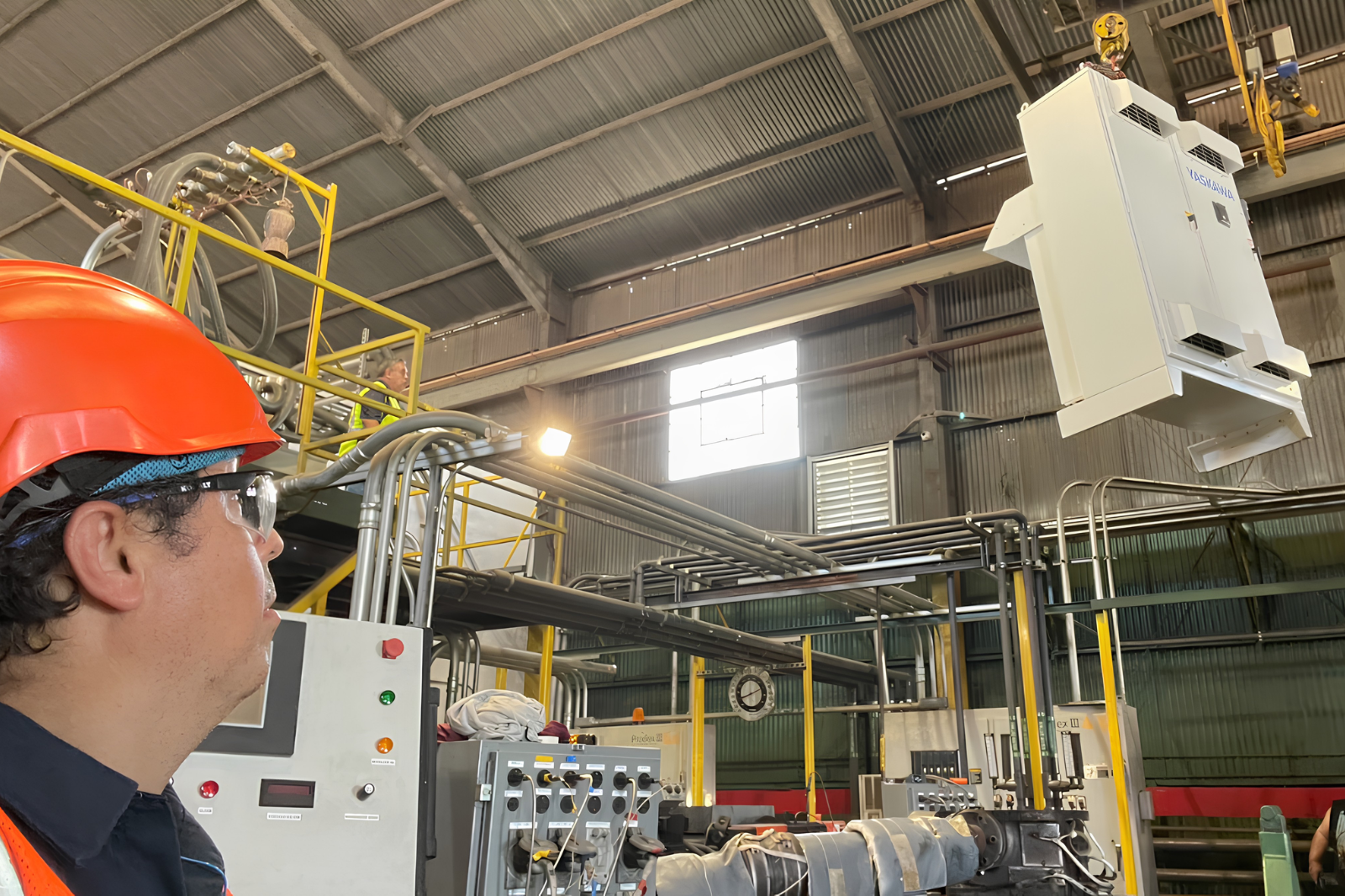
Photo Source: Control Concepts
Older DC drive and motor systems can run reliably for decades, so age alone isn’t a reason to replace one. The decision usually comes down to what it’s taking to keep that system running.
If repairs are becoming more frequent, parts are getting harder to find, routine motor maintenance is increasing, or downtime is becoming harder to tolerate, it may be time to look at converting the system to AC.
Here’s how to decide when another DC repair still makes sense and when a DC-to-AC conversion may be the better long-term move.
When should you convert a DC drive and motor system to AC?
A DC-to-AC conversion usually makes sense when reliability, maintenance, parts availability, or downtime are becoming bigger problems than the cost and effort of upgrading the system.
There’s rarely one sign that tells you it’s time. More often, several smaller problems start adding up.
Maybe the drive has become difficult to source. Maybe the motor needs more frequent attention. Maybe you’re considering another repair and realizing you could be having the same conversation again a year from now.
DC motors also have maintenance requirements that AC motors don’t, including brushes and commutators that wear over time and require routine inspection and service.
That doesn’t mean every older DC system should be replaced. If yours is reliable, supportable, and still well suited to the application, replacing it simply because it’s old might not make financial sense.
Sometimes another repair is still the right answer. Sometimes replacing the drive while keeping the existing motor makes sense. And sometimes the entire drive-and-motor system has reached the point where moving to AC is the better long-term investment.
What actually changes during a DC-to-AC conversion?
A proper DC-to-AC conversion involves more than replacing the old DC drive with a VFD. The motor, controls, electrical system, environment, and mechanical load all have to work together.
The replacement AC motor has to provide the torque and speed the machine actually requires. The drive has to be sized and configured for both the motor and the load. The existing electrical system has to support the new equipment, and the machine controls still have to communicate with it correctly.
Depending on the application, a retrofit may include:
- A new AC motor and VFD sized for the machine’s actual torque, speed, and duty requirements.
- Electrical upgrades such as breakers, conduit, conductors, disconnects, or enclosure changes.
- Control integration with the existing PLC, HMI, safety circuits, and machine controls.
- Cooling and enclosure changes based on the temperature and environment where the equipment operates.
- Startup, tuning, and commissioning so the new system performs properly under the real production load.
Control Concepts recently completed this type of project for Pacific Corrugated in Fontana, California. Two extrusion systems with 250 HP and 400 HP DC drive-and-motor systems were converted to Yaskawa GA800 drives and AC vector motors.
The project also included new circuit breakers, conduit, conductors, control integration, startup, testing, and tuning. You can see the full project in the Pacific Corrugated case study.
Can you keep your existing PLC and controls?
Often, yes. Converting the motor and drive to AC doesn’t automatically mean you have to replace the PLC, HMI, or the rest of the machine’s control system.
If the existing controls are still reliable and the replacement drive can be integrated with them correctly, there may be no reason to rebuild the entire controls architecture.
That can make a big difference in both the cost and scope of a retrofit.
At Pacific Corrugated, Control Concepts integrated the new AC drive systems with the plant’s existing Allen-Bradley controls rather than replacing controls that were still doing their job.
Whether that’s possible on another machine depends on the control signals, communication method, feedback requirements, safety system, and capabilities of the replacement equipment.
Before assuming an AC conversion means replacing everything, find out what can stay.
What should you evaluate before converting from DC to AC?
Look at the entire machine and how it actually operates, not just the horsepower on the old motor or the failed drive sitting in front of you.
Horsepower matters, but it doesn’t tell the whole story. Before selecting a replacement system, you need to understand:
- Torque and speed. What does the machine need at startup, normal operating speed, and low speed?
- Acceleration and deceleration. How quickly does the load need to speed up or slow down?
- Duty cycle and overload conditions. How long does the motor run under load, and how often does it see heavier-than-normal demand?
- Feedback requirements. Does the application need precise speed or torque control?
- Existing controls. Can the PLC, HMI, feedback devices, and safety circuits remain?
- Electrical infrastructure. Will breakers, wiring, conduit, grounding, or disconnects need to change?
- Operating environment. What heat, dust, moisture, contamination, or ventilation issues does the equipment have to handle?
- Downtime. How long can the machine realistically be out of production for the conversion?
- Machine life. How many more years do you expect to keep the equipment?
The operating environment is especially easy to underestimate. A drive that works perfectly in one facility may need a completely different enclosure or cooling setup somewhere else.
At Pacific Corrugated, the new equipment had to operate in ambient temperatures up to 50°C, so the drives were installed in NEMA 3R enclosures with additional cooling.
The right drive in the wrong enclosure is still the wrong installation.
For more background on the drive platform used in that project, see What Is a Yaskawa Drive? Applications and Reliability.
What are the main benefits of converting a DC system to AC?
The biggest benefits are often easier long-term support, less routine motor maintenance, and moving the machine onto equipment that’s easier to source and maintain.
An AC motor eliminates the brushes and commutator that require routine service on a traditional DC motor. A conversion can also be an opportunity to address older wiring, enclosure problems, inadequate cooling, or control issues that have become harder to maintain over time.
Depending on the application, the practical benefits may include:
- Improved reliability
- Reduced routine motor maintenance
- Better parts availability
- Easier long-term technical support
- Lower risk of prolonged downtime
I wouldn’t automatically make energy savings the reason to convert. They may matter in some applications, but reliability, maintenance, parts availability, and production risk can be the stronger business case.
The reason for converting should match the problem you’re actually trying to solve.
When does repairing the existing DC system still make sense?
Repair may still be the better choice when the equipment is supportable, failures are infrequent, and the cost and downtime of a conversion outweigh the problems the existing system is causing.
Not every aging DC system needs to become a modernization project.
If the motor is still in good condition, the drive can be repaired or replaced economically, parts are available, and the system isn’t creating recurring production problems, keeping the DC platform may still make sense.
Instead of asking only how old the equipment is, ask:
What is this system costing us to own and support now, and what’s likely to happen over the next several years?
Look at repair history, maintenance hours, parts availability, production risk, downtime, upgrade cost, and how long the machine itself is expected to remain in service.
The same basic thinking behind deciding whether to repair or replace a failed VFD applies here too. The lowest-cost option today isn’t always the lowest-cost option over the life of the machine.
What did a real DC-to-AC conversion involve?
A good retrofit keeps what still works, replaces what no longer makes sense to support, and designs the new equipment around the actual machine and operating environment.
That’s what Control Concepts did at Pacific Corrugated.
The facility had two extrusion systems running 250 HP and 400 HP DC drive-and-motor systems. Control Concepts converted both to Yaskawa GA800 drives and AC vector motors.
The project went beyond the drive and motor replacement. It included new circuit breakers, conduit and conductors, integration with the existing Allen-Bradley controls, NEMA 3R enclosures with additional cooling for the plant environment, and complete startup, testing, and tuning.
The existing controls didn’t need to be replaced just because the motor technology changed. Parts of the system that were still useful stayed in place, while the aging DC equipment was moved to a modern AC platform.
That’s really the point of a thoughtful modernization project. You don’t replace everything because it’s old. You figure out what’s still working, what’s becoming a liability, and what combination gives the machine the best path forward.
Frequently Asked Questions
Can any DC motor and drive system be converted to AC?
Many can, but the replacement system has to be selected around the machine’s torque, speed, controls, electrical requirements, and operating environment. Matching horsepower alone isn’t enough.
Do I have to replace my PLC when converting from DC to AC?
Not necessarily. Existing PLC and HMI systems can often remain if the replacement drive can be properly integrated with the existing controls. Pacific Corrugated retained its Allen-Bradley control system during its conversion.
Does an AC motor require less maintenance than a DC motor?
Generally, yes. A traditional AC motor doesn’t use the brushes and commutator that require routine attention on a DC motor. Bearings and other mechanical components still require normal maintenance.
Can I reuse my existing wiring and breakers?
Sometimes, but you shouldn’t assume that you can. The new drive-and-motor system may require changes to breakers, conductors, conduit, grounding, disconnects, or other electrical infrastructure.
Should I wait until my DC system fails before converting it?
Not necessarily. If failures, maintenance, or parts availability are already becoming a problem, planning the conversion during a scheduled outage can give you much more control than waiting for an emergency failure.
Trying to decide whether another DC repair still makes sense?
If you’re keeping an aging DC system running and trying to decide between another repair, replacement equipment, or a full DC-to-AC conversion, talk it through with Control Concepts.
We can look at the load, controls, environment, maintenance history, parts availability, and downtime risk, and help you determine which path actually makes sense for the machine.
If you want to see what this kind of conversion looks like in the field, take a look at the Pacific Corrugated DC-to-AC conversion case study.